



Here I present my experience in strategizing and the results of studying theoretical research on this topic. Both matter. A scientist observes the physical world, models it, and develops more efficient concepts. An entrepreneur applies these concepts and transforms the physical world. This creates continuous cyclical development. I stand on the side of the entrepreneur and mentor, so I am primarily interested in practical application and achieving real results.
Why do we use the word “Strategizing”?
Because we see it as a process, not an end result. Because an entrepreneur must develop it personally, live through it, make decisions. And because it must have flexibility - the ability to be revisited. This is a subtle point, but it must be understood so as not to get stuck waiting for a train that has long departed. The world is changing very quickly; new inputs and insights appear constantly, so strategy must be continuously tested for validity. Is this really the direction I want to go? At the same time, you cannot jump from side to side every time – there must be a cycle (year–quarter), but also room to use emerging opportunities.
There are different schools of strategy.
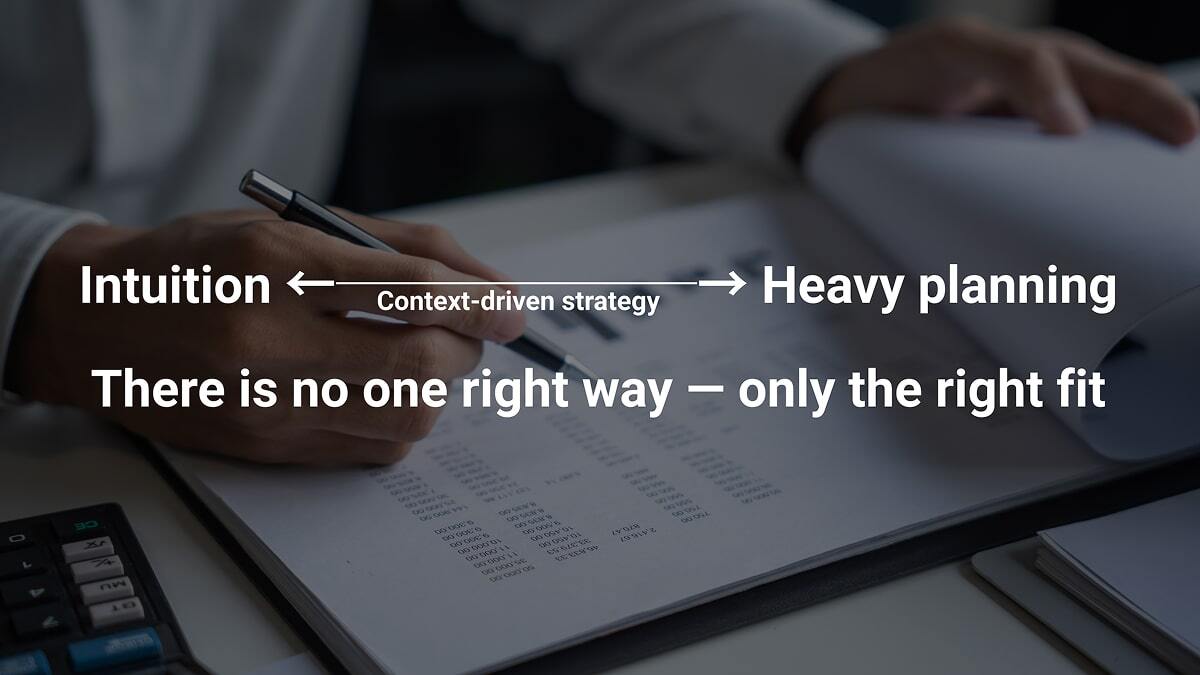
Henry Mintzberg and his co-authors did very systematic work by summarizing and analyzing them in the book “Strategy Safari.” I will not go deep into a retelling here, but in short, the differences lie in planning vs. flexibility, instrumentality, and responsibility for developing and making key decisions. For example, there may be a situation where all strategic decisions are made by one entrepreneur intuitively (yes, this is also strategizing). And on the opposite side – a complex process of analyzing and synthesizing information about the market, competitors, trends, internal situation, developing scenario projections, identifying strategic alternatives, collective multi-step decision-making, developing functional plans, creating implementation roadmaps, budgeting, etc. As usual, the truth is somewhere in the middle. In my view, it strongly depends on the personality of the entrepreneur, the business lifecycle, the situation inside the company, and the market context. I will describe my own approach below…
Henry Mintzberg and his co-authors did very systematic work by summarizing and analyzing them in the book “Strategy Safari.” I will not go deep into a retelling here, but in short, the differences lie in planning vs. flexibility, instrumentality, and responsibility for developing and making key decisions. For example, there may be a situation where all strategic decisions are made by one entrepreneur intuitively (yes, this is also strategizing). And on the opposite side – a complex process of analyzing and synthesizing information about the market, competitors, trends, internal situation, developing scenario projections, identifying strategic alternatives, collective multi-step decision-making, developing functional plans, creating implementation roadmaps, budgeting, etc. As usual, the truth is somewhere in the middle. In my view, it strongly depends on the personality of the entrepreneur, the business lifecycle, the situation inside the company, and the market context. I will describe my own approach below…
There is an ongoing discussion about whether startups need Strategy.
By “startup,” I mean a project that creates a disruptive or sustaining innovation – not a copycat project. In my view, strategy becomes necessary at the stage when the idea is validated in the market and first sales appear. Yes, at the earliest stage it is better to use Lean Startup and Customer Development approaches – when you need to identify and validate a problem or an inefficiently performed important job, create a solution, confirm that it performs significantly better than existing alternatives. But then the world becomes huge – a multitude of customer segments, resulting from this: values, product requirements, pricing, communications, channels… You can move intuitively, but in my view it will be longer, more expensive, and possibly already too late. And intuition-based paths often work only for geniuses and often rely on luck. You can hope for it, but you shouldn’t rely on it.
Why else do startups need Strategizing?
They typically start very intuitively and reach a point where things begin to work: first clients appear, the team expands. Clients want more and more, requirements often conflict. There is confusion about what to prioritize, how to combine the incompatible, first frustrations appear, cash gaps may follow… The entrepreneur gets pulled into the daily routine of “patching holes.” But the main job of an entrepreneur is to think! And this ends up happening on a leftover basis – meaning it doesn’t happen at all. This is why my job is to ensure this time appears, that thinking happens during productive hours and regularly. As a result, focus emerges – clarity on what (or whom) we must let go, work becomes more predictable and meaningful.
What should strategy focus on?
Depending on the founders’ goals, business goals, market situation, competition, trends, and internal context, strategy may focus on:
Why should Strategizing be done by the entrepreneur and team, not by an external consultant or mentor?
I’ve gone through strategy development with consultants several times. Usually everything looks logical and beautiful – and then goes into a drawer. In my view this happens because you didn’t “live through the information,” you didn’t pass it through your personal filter, and the conclusions, while logical, may not align with your personal goals and values. Moreover, if you do the work yourself, you gain a much deeper understanding of the market and customers, you invest your scarce time resource, and you essentially catch the “strategizing virus,” commit to it, and start executing.
A strategy needs both rigid and flexible parts. We can define market boundaries (product and geographic), the target audience, and even the product. But there must always be room for experiments. We can test channels, communication messages. We track client feedback and new insights arise for the business model. This is one possible case; many others exist. What matters is understanding the principle of rigidity and flexibility in strategizing.
How does this work in our case?
It is important to note that you cannot create a full strategy during a strategic session. This is my conviction and experience. A strategy is calculated, understood, and matures over 2-3 months – and then continues to evolve as new inputs and market signals appear. A strategy session is where you can “sell” the idea to the team or use sessions as synchronization tools.
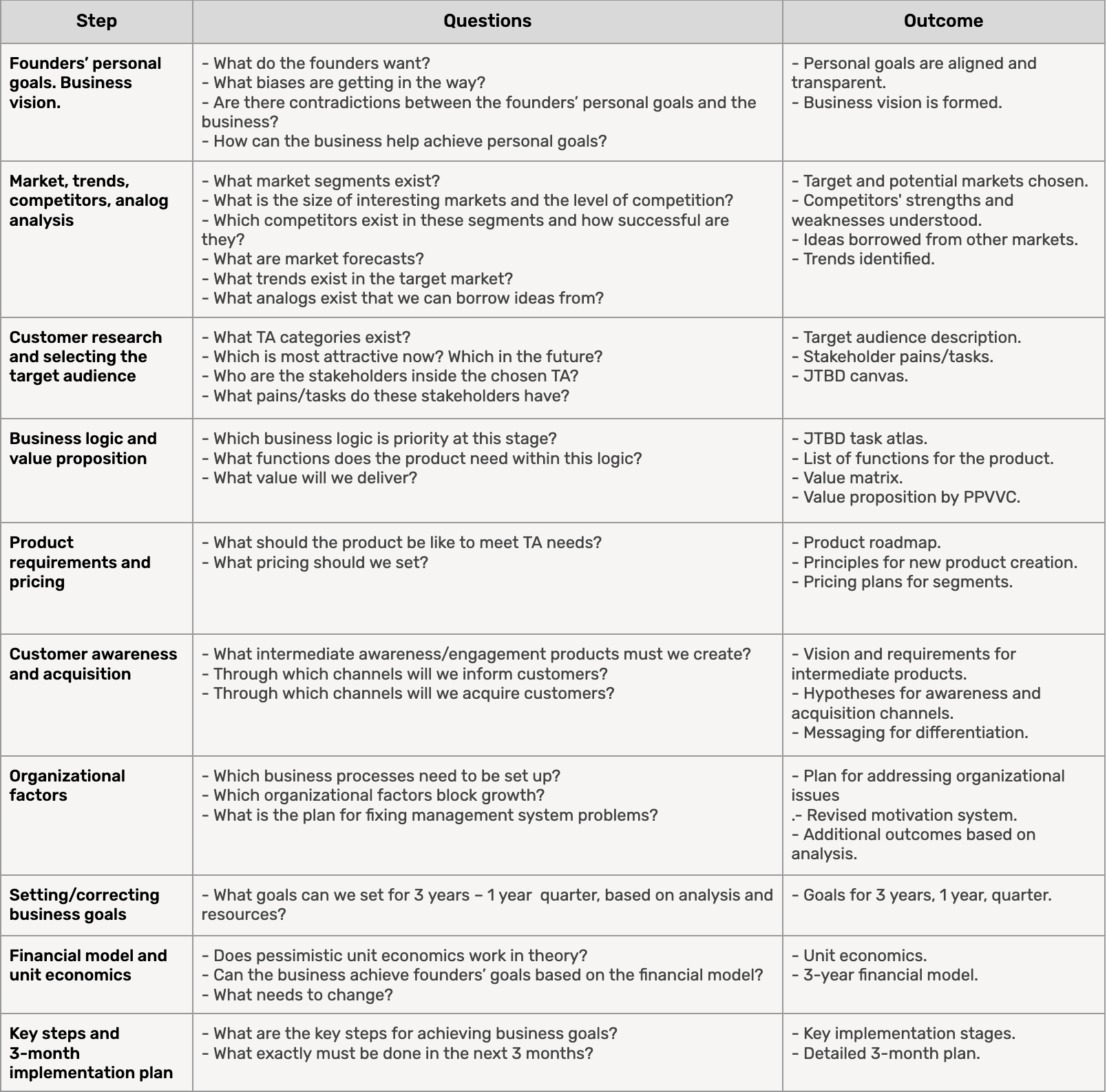
Below, I briefly outline one possible process of strategy development. Depending on the situation, the structure and format may vary significantly.
Depending on the founders’ goals, business goals, market situation, competition, trends, and internal context, strategy may focus on:
- Competing for the customer,
- Competing with competitors,
- Internal efficiency,
- Quickly leveraging emerging opportunities. Often this becomes a mix, but focus always exists, and it must be considered throughout strategizing.
Why should Strategizing be done by the entrepreneur and team, not by an external consultant or mentor?
I’ve gone through strategy development with consultants several times. Usually everything looks logical and beautiful – and then goes into a drawer. In my view this happens because you didn’t “live through the information,” you didn’t pass it through your personal filter, and the conclusions, while logical, may not align with your personal goals and values. Moreover, if you do the work yourself, you gain a much deeper understanding of the market and customers, you invest your scarce time resource, and you essentially catch the “strategizing virus,” commit to it, and start executing.
A strategy needs both rigid and flexible parts. We can define market boundaries (product and geographic), the target audience, and even the product. But there must always be room for experiments. We can test channels, communication messages. We track client feedback and new insights arise for the business model. This is one possible case; many others exist. What matters is understanding the principle of rigidity and flexibility in strategizing.
How does this work in our case?
It is important to note that you cannot create a full strategy during a strategic session. This is my conviction and experience. A strategy is calculated, understood, and matures over 2-3 months – and then continues to evolve as new inputs and market signals appear. A strategy session is where you can “sell” the idea to the team or use sessions as synchronization tools.
Below, I briefly outline one possible process of strategy development. Depending on the situation, the structure and format may vary significantly.